Understanding Your Control

One of the best ways to simplify your life is to understand what’s in your control and what is not.
We all have a finite amount of time and energy in our day. Thinking about, acting on, and attempting to change situations can take up a large part of that time and energy.
When you spend that energy on things you do have control over, you can make progress.
However, when we spend our energy focusing on situations we don’t have control over, we can waste our time and increase our stress and frustration.
Spectrum of Control
What makes understanding control in your life difficult is that it’s often a spectrum.
There are some things that you have almost complete control over, like what you choose to eat. There are other things, like whether the sun keeps rising, that you have no control over.
It’s the things in the middle of the spectrum that get tricky and require you to acknowledge to what degree you can productively make a change.
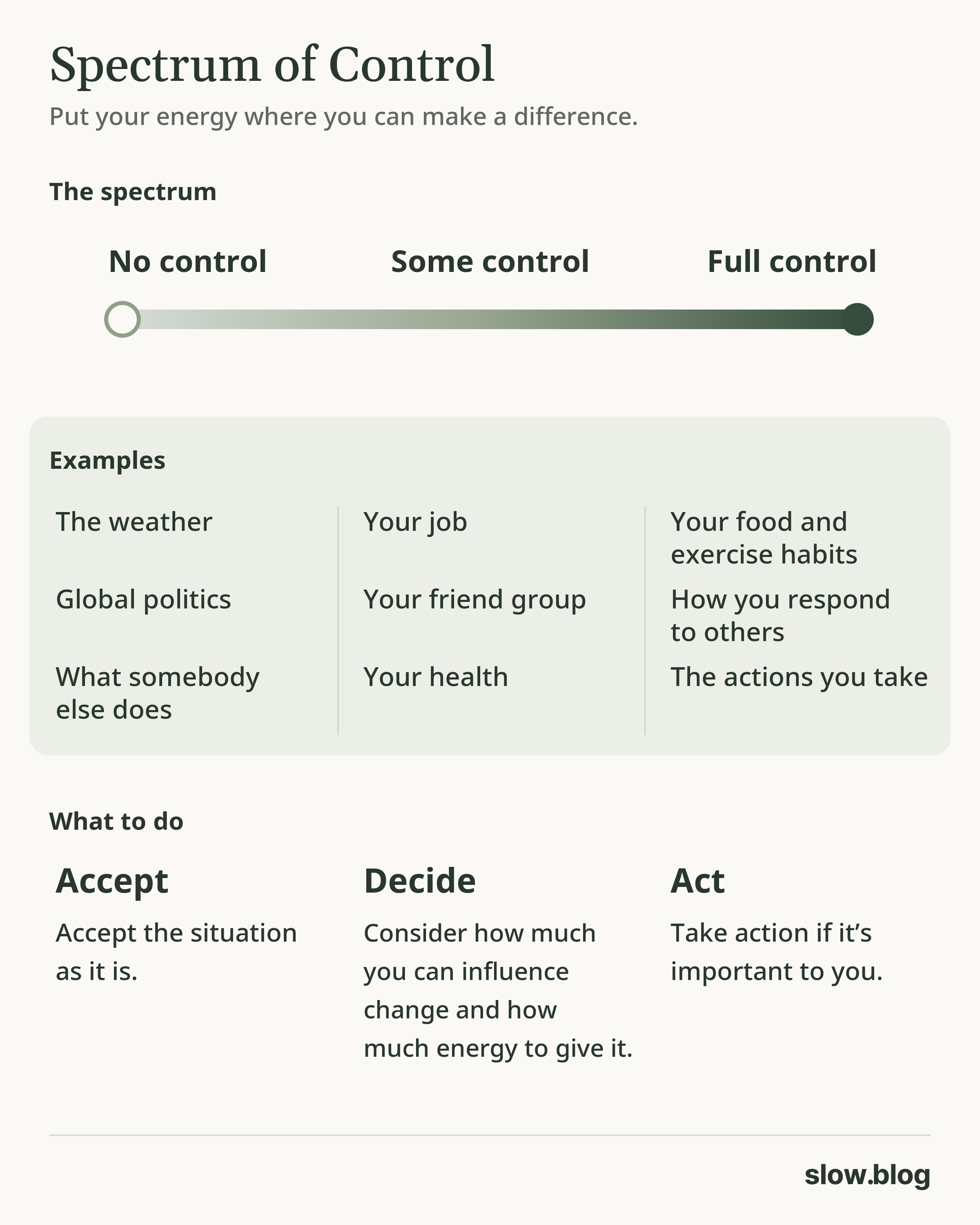
I call this the spectrum of control. On one side is no control; on the other is full control.
Looking at the situations in your life through the lens of how much control you have allows you to prioritize your energy. The more energy you put into things under your control, the more powerful the outcome.
How many people do you know who will spend half of their day worried about the current big political scandal, while at the same time neglecting to eat well and exercise? Or do you know somebody who hates their job but refuses to change it or try to work out an issue with their company? “Work will always suck,” they say.
Our quality of life depends in part on understanding how much control we have.
By blaming external powers for things that are under our control, we give up the chance to act. Conversely, by trying to change things we have little control over, we can spend a lot of energy making little progress.
Slowing Down to Understand Your Control
For every situation you encounter, ask yourself, “Where does this fall on my spectrum of control?”
If it’s on the full control side, take action if it’s important to you.
If it’s in the middle, decide how much you can influence change and how much energy you want to put into taking action.
If it’s on the no control side, you need to accept the situation as it is.
Slowing down gives us space to see the difference. We can put our energy where it matters and let go of what isn’t ours to control.